
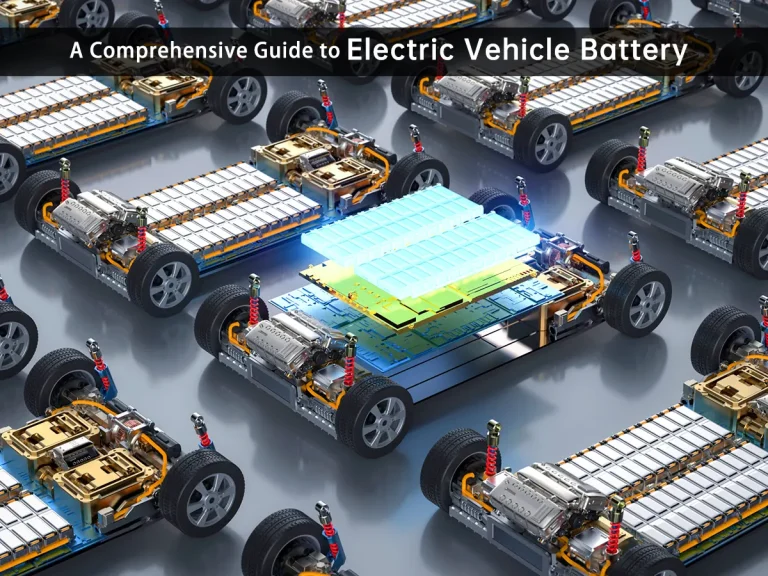
With the rapid development of science and technology, the performance of electric vehicle battery has gradually improved. For electric vehicles, the core is the battery, which accounts for 40% to 60% of the cost of the whole vehicle.
Do you know what types of batteries are used in electric vehicles? What are the characteristics of these batteries? This article will introduce in detail the types and characteristics of electric vehicle battery, the status of electric vehicle battery after 8 years of use, and the solid-state batteries that are being developed.


Which battery is used in electric vehicles?
Lithium ion battery
What is a lithium ion battery? Lithium-ion battery is a battery that relies on lithium ions internally and electrons moving between positive and negative electrodes externally to function. The energy density of lithium-ion batteries is relatively high and can be recycled. Ternary lithium batteries and lithium iron phosphate batteries are lithium-ion batteries. The following is a detailed introduction:
Advantages:
- Lightweight: Compared with other types of batteries, lithium batteries have a smaller size and weight, making them easier to carry and use.
- High specific energy: Lithium batteries have a higher specific energy and can provide a larger amount of energy storage, making them an excellent energy source.
- No memory effect: Lithium batteries have no memory effect and do not need to be fully discharged and recharged.
- Stable performance: Lithium batteries have a relatively low consumption rate and a long service life. Integrated circuits can also effectively control the battery power and ensure stability.
- Environmentally friendly and safe: Lithium batteries do not contain flammable and explosive organic substances, so they are more environmentally friendly and safe.
Disadvantages:
- Battery life: The life of lithium batteries is affected by factors such as the number of charge and discharge cycles and temperature, so you need to pay attention to the correct use method.
- Safety hazards: Since lithium batteries become unstable under conditions such as overcharge, overdischarge, and high temperature, they may explode or catch fire, so they need to be used and stored reasonably.
- High price: Compared with other types of batteries, lithium batteries are more expensive.
- Not suitable for low temperature environments: The capacity and cycle life of lithium batteries will decrease under low temperature conditions, so they are not suitable for extremely low temperature environments.
- Charging speed: The charging speed of lithium batteries is slower than that of other types of batteries.
Lithium batteries have great advantages in lightweight, high energy storage, stability, and no memory effect. But there are also some problems that need to be paid attention to, such as safety hazards and high prices.

Ternary lithium battery
Ternary lithium battery (NMC battery)refers to a lithium battery whose cathode material is lithium nickel cobalt manganese ternary cathode material.
Advantages:
- Small size: The new lithium battery is small and light
- Excellent cycle performance: At room temperature, the cycle stability is good
- High energy density: The energy density is 200-300Wh/kg, which is higher than the energy density of other types of batteries
- Low self-discharge rate and no memory effect
- Ternary lithium battery is more stable at low temperatures
Disadvantages: The battery is unstable at high temperatures and is prone to thermal runaway.
Representative models: BAIC New Energy EV200, BAIC New Energy EU260, Tesla Model 3, etc.
Lithium iron phosphate battery
Lithium iron phosphate battery(LFP battery) is a lithium-ion battery that uses lithium iron phosphate as the cathode material. (The cathode materials of lithium-ion batteries mainly include lithium cobalt oxide, lithium manganese oxide, lithium nickel oxide, ternary materials and lithium iron phosphate, etc.)
Advantages:
- Ultra-long life: The number of cycle charging can reach more than 3,000 times
- Green and environmentally friendly: does not contain heavy metals and is environmentally friendly
- High safety performance: It is not easy to have thermal runaway at high temperatures, and the stability is optimal
Disadvantages: Compared with ternary lithium batteries and lithium cobalt oxide batteries, the energy density is still far behind. In addition, when the temperature is below -5℃, the charging efficiency is reduced. And when the temperature is too low, it will affect the capacity of the battery. Vehicles using lithium iron phosphate batteries are not suitable for use in extremely cold areas, because the temperature in winter is too low, which will affect the service life of lithium iron phosphate batteries.
Representative models: BYD e6, BYD Qin, BYD Tang, etc.
Nickel-metal hydride battery
Nickel-metal hydride battery (NiMH battery) is a new product developed on the basis of nickel-cadmium battery in the late 1980s, which is synthesized by hydrogen ions and metal nickel.
Advantages: The battery has a large energy reserve, is lighter in weight, and does not pollute the environment.
Disadvantages: The manufacturing cost is too high, and the performance is worse than that of “lithium battery”.
Representative models: Toyota Prius, Ford Escape, Chevrolet Malibu, etc.
Hydrogen fuel cell
Although the word “battery” is included in the word “fuel cell”, it is not a traditional energy storage device, but a power generation device. This is the biggest difference between fuel cells and traditional batteries.
Hydrogen is the main fuel for fuel cells. From the perspective of fuel safety, hydrogen is non-toxic and harmless. The reactant is water, which is non-toxic, harmless, green and clean. Hydrogen has a low density. When high-pressure hydrogen leaks and burns, it forms an upward torch and does not spread to the surroundings.
Therefore, hydrogen safety is higher than fossil fuels such as natural gas and oil. From the performance point of view, the energy density of fuel cells can reach 500Wh/kg, and the cycle life is more than 4,000 times, which is better than lithium batteries.
Advantages: very high energy density; short hydrogen filling time
Disadvantages: safe use of hydrogen; high storage and transportation costs; technology has not been industrialized and has not been verified by the market; cannot be connected to the grid for charging.
For example, Toyota Mirai and Hyundai Nexo, but failed to marketize. At present, the key application and development of hydrogen fuel cells is in the field of commercial vehicles.
The developing electric vehicle battery - solid-state battery
Compared with liquid batteries, solid-state batteries have some advantages such as long driving range, low cost, high safety and longer life. However, as a new technology, solid-state batteries are still in the research and development stage, the technology is not yet mature, and the production cost is relatively expensive.
At present, global automobile manufacturers are also actively overcoming the technical difficulties of solid-state batteries, including some manufacturers such as Weilai and CATL are actively developing solid-state batteries.
Previously, CATL also released a new product called “condensed battery”, which can achieve an energy density of 500Wh/kg, which is almost 1.5 times the energy density of the current ternary lithium battery. But it is not a semi-solid battery in the traditional sense, but a new form of battery.
At present, the driving range of most liquid batteries is only between 400km and 600km, and the driving range of solid-state batteries can easily exceed 1000km, and the charging speed is more than 3 times faster than that of liquid batteries.
If solid-state batteries are widely used in electric vehicles, it will greatly accelerate the development of electric vehicles.

What happens to EV batteries after 8 years?
After 8 years of use, the electric vehicle battery may have problems such as capacity decay. The life and replacement of ev batteries are the core issues that car owners are most concerned about. Combining the latest industry data and expert opinions, the answer can be summarized as: the battery life is far more than 8 years, but the handling after the 8-year warranty expires requires scientific decision-making.
The following are the key truths:
Battery life ≠ warranty period, 8 years is just the starting point
The 8-year or 120,000-kilometer battery warranty period is essentially a commitment by the car company to the quality of the battery, not the actual end of the battery life.
According to measured data: The cycle life of lithium iron phosphate batteries is about 3,000 times. Calculated by charging twice a week, it can be used for about 28 years (3,000 times ÷ 2 times/week ÷ 52 weeks ≈ 28.8 years)
The cycle life of ternary lithium batteries is about 2,000 times, and it can be used for 19 years at the same frequency. Even considering the calendar life (natural aging of materials), mainstream batteries can last 8-10 years under normal use. Assuming a mileage of 20,000 kilometers per year, the battery of a pure electric vehicle can still maintain 80% of its capacity after running 160,000 to 200,000 kilometers.
Do I need to replace the battery after 8 years?
The key is to look at these 3 tests. After the warranty expires, professional tests are required to determine the battery status:
- Health test: If the battery capacity is ≥80%, it can continue to be used
- Consistency test: Check the differences between cells in the battery pack. Too large differences can easily cause failures
- Safety test: Check the sealing and insulation of the battery pack.
There are three options based on the results:
- Continue to use: Good health and no safety hazards
- Ladder utilization: Batteries with capacity decay to 30%-80% can be converted into energy storage equipment (such as backup power for charging stations)
- Scrap recycling: Batteries with a capacity of less than 30% or safety hazards are disassembled to extract lithium, cobalt and other materials.
From this we can conclude that whether electric vehicle batteries need to be replaced requires professional testing and evaluation. Eight years of battery use does not mean the end of its life. After eight years of use, the capacity of some batteries will decline, while the performance of some batteries will remain stable and can continue to be used. Therefore, it is necessary to evaluate whether the battery needs to be replaced based on different situations.

How to use electric vehicle battery correctly?
Electric vehicles are driven by power batteries, so the maintenance of the battery is directly related to the performance of the vehicle. So how to protect the electric vehicle battery in daily use?
Charging time: Slow charging is recommended. Electric vehicle charging methods are divided into fast charging and slow charging. Slow charging generally takes 8 to 10 hours, while fast charging generally charges 80% of the power in half an hour and can be fully charged in 2 hours. However, fast charging uses a larger current and power, which will have a greater impact on the battery pack. Charging too fast will also cause battery virtual power, which will reduce the life of the power battery over time. Therefore, if time permits, slow charging is preferred. However, the charging time should not be too long, otherwise it will cause overcharging and make the vehicle battery hot.
Pay attention to the power: avoid deep discharge. Electric vehicles generally remind you to charge as soon as possible when the remaining power is 20% to 30%. If you continue to drive at this time, the battery will be deeply discharged, which will also shorten the battery life. Therefore, when the battery has little power left, charge it in time.
Long-term parking: If the vehicle is to be parked for a long time, be sure not to let the battery run low. When the battery is running low, it is easy for sulfation to occur. Lead sulfate crystals adhere to the plates, which will block the ion channels, causing insufficient charging and reducing the battery capacity. Therefore, electric vehicles should be fully charged when parked for a long time. It is recommended to charge regularly to keep the battery healthy.
Prevent the charging plug from overheating: For plug-in charging electric vehicles, the charging plug also needs attention. First of all, keep the charging plug clean and dry. When charging, the power plug or charger output plug is loose, the contact surface is oxidized, etc., which will cause the plug to heat up. If the heating time is too long, the plug will short-circuit or have poor contact, damaging the charger and battery. Therefore, if there is a similar situation, replace the connector in time.
“Warming up” is necessary in winter: In low temperatures in winter, battery performance will be greatly reduced, resulting in low charging and discharging efficiency, reduced electric vehicle battery capacity, and reduced mileage. Therefore, warming up the car in winter is necessary, and driving slowly to warm up the car allows the battery to gradually heat up in the coolant to help the battery work.

Conclusion
Based on the above batteries, the mainstream ev batteries on the market are mainly ternary lithium batteries and lithium iron phosphate batteries. However, most of the newly launched electric vehicles basically use ternary lithium batteries. The main reason is that the battery energy density of ternary lithium batteries is much higher than that of lithium iron phosphate, and it is more stable at low temperatures. However, from the perspectives of safety and repeated service life, the performance of lithium iron phosphate batteries is better than that of ternary lithium batteries.
Driven by scientific and technological progress and the market, I believe that one day many high-performance batteries (such as supercapacitor batteries and bio-batteries) will be used in electric vehicles.


